- Opening hours by appointment
- +41-78 7 141415
- [email protected]


Brainwaves
Biofeedback Modalities & Brainwaves - The "Language" of the Nervous System
In EEG neurofeedback, specific frequency bands are trained at defined locations of the brain.
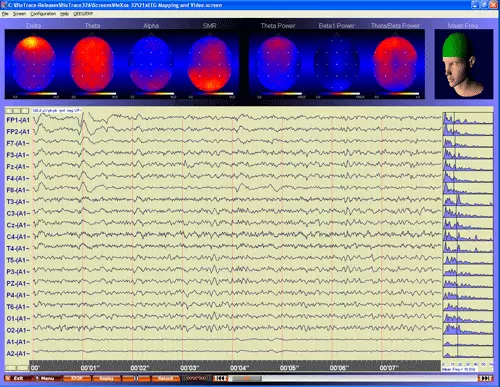
Screenshot of Nexus 32 and BioTrace+ software © mindmedia.nl
The key brainwave bands:
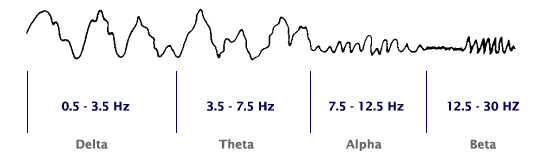
| Frequency Band | Range | Meaning | Typical Clinical Relevance |
|---|---|---|---|
| Delta | Approx. 0.5-4 Hz | Deep sleep, physical regeneration | Too much during waking: slowing, cognitive decline, brain injuries |
| Theta | Approx. 4-8 Hz | Creativity, daydreaming, light trance | Too much fronto-central: inattention, ADHD; therapeutically useful for trauma processing |
| Alpha | Approx. 8-13 Hz | Relaxed wakefulness, inner calm | Too little: tension, anxiety, rumination; training focus: relaxation and stress reduction |
| SMR | Approx. 12-15 Hz | Calm attention with physical stillness | Effective for ADHD, sleep disorders, epilepsy (SMR training) |
| Beta | Approx. 15-30 Hz | Thinking, concentration, problem-solving | Too little: lack of drive; too much high-beta: anxiety, over-arousal, insomnia |
| Gamma | >30 Hz | Peak performance, integration, "aha" moments | Training for cognitive performance and advanced meditation |
Dysregulations in these frequencies, for example an elevated theta/beta ratio in ADHD, excessive high-beta in anxiety, or frontal alpha asymmetry in depression, are well documented and form the basis of individual training protocols.