- Opening hours by appointment
- +41-78 7 141415
- [email protected]


Neurofeedback
Neurofeedback = Biofeedback for the Brain
What Is Neurofeedback?
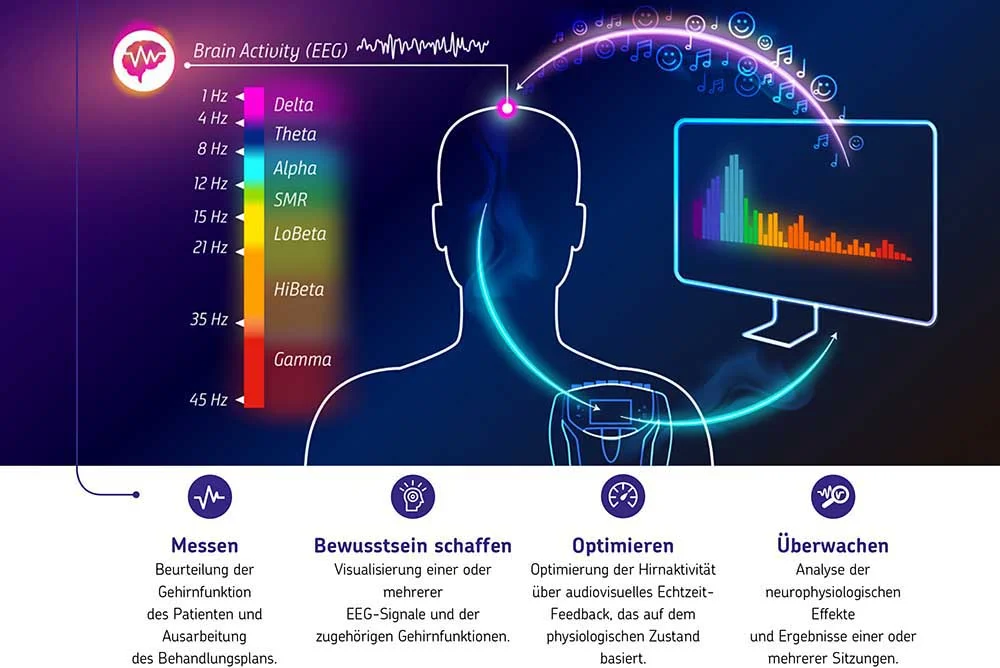
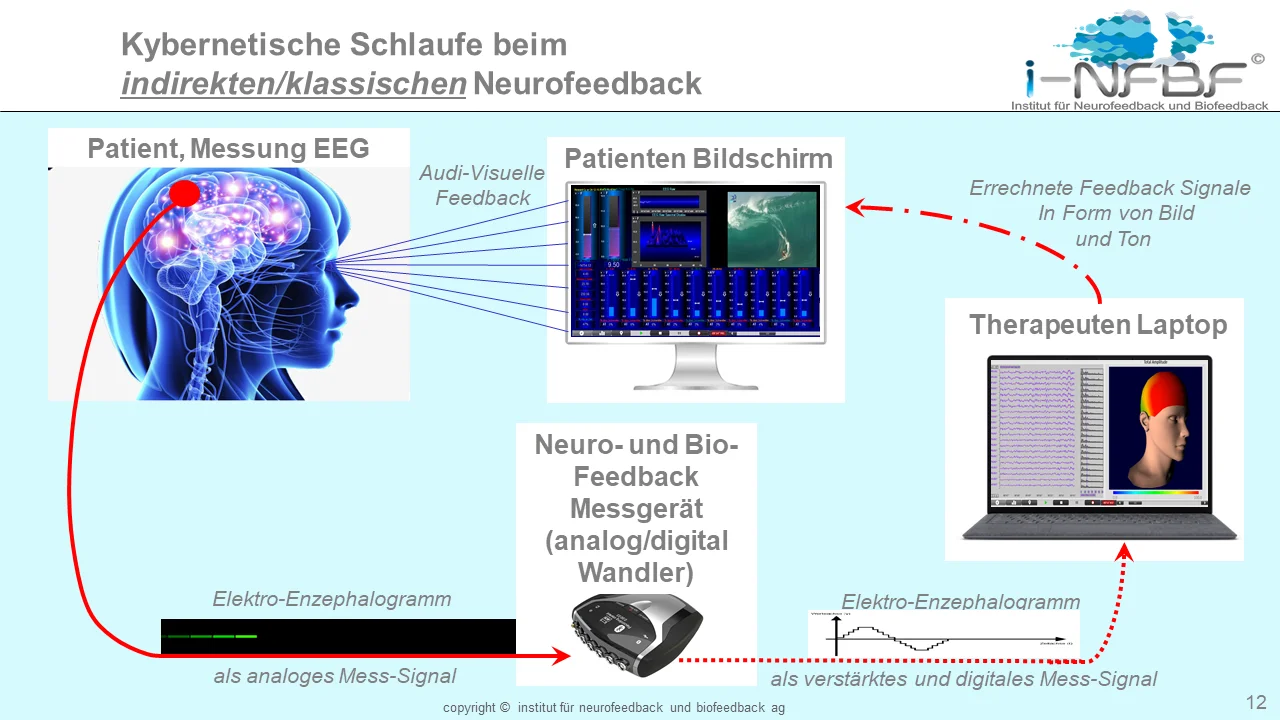
Neurofeedback (EEG biofeedback) is "biofeedback for the brain": brainwaves are measured on the scalp via electroencephalogram (EEG), analysed by software, and compared with normative data. On this basis, the person being treated receives targeted feedback, usually via a video, a game, or music, that prompts the brain to change dysregulated activity patterns and stabilise healthier patterns.
Indirect vs. Direct Neurofeedback
| Method | Principle | Example |
|---|---|---|
| Indirect neurofeedback | The EEG is measured, and the brain receives visual or auditory feedback when activity deviates from the target. | Classical frequency/SMR training, Z-score neurofeedback |
| Direct neurofeedback (MCN) | The EEG is measured; the system delivers ultra-small electrical impulses in the pico-volt range back via the electrodes to interrupt entrenched patterns. | Microcurrent neurofeedback (MCN) following the UCLA protocol |
Properties of Neurofeedback
- Pain-free: Only sensors are attached; there is no classical microcurrent stimulation in standard neurofeedback.
- Non-invasive and medication-free: No substances are introduced into the body; there are no pharmacological side effects.
- Learning-based: The brain is not influenced from outside but learns to regulate itself better through operant conditioning and neuroplasticity.
From Measurement to the Individual Training Plan
At the I-NFBF, every bio- and neurofeedback therapy is based on a structured assessment and a clearly defined treatment plan.
Step 1: Clinical History
A thorough discussion about complaints, pre-existing conditions, medications, life situation, and goals such as symptom relief, performance enhancement, burnout prevention, or cognitive rehabilitation.
Step 2: Neurobiological Stress Profile
Standardised psychophysiological assessment following the Harvard Medical School standard of Dr Inna Khazan, in which HRV, EMG, skin conductance, respiration, temperature, and pulse are measured under resting and stress conditions. The evaluation yields reactivity, recovery ability, and resilience of your autonomic nervous system.
Step 3: QEEG - Quantitative EEG
A QEEG records your brainwave profile at rest (eyes closed/open) and, if applicable, under task conditions, and compares it with an age-matched normative database (Z-scores). This makes it possible to identify over- and under-activity of regions, network dysfunctions, paroxysmal activity, and cognitive profiles objectively.
Step 4: Integrative Evaluation
Clinical history, QEEG, stress profile, HRV, and, if applicable, metabolic analyses are combined to create an individual neuro-psychophysiological profile. On this basis, training goals, suitable bio-/neurofeedback modalities, and additional supportive measures are determined.
Step 5: Individual Training Plan
| Component | Content |
|---|---|
| Neurofeedback | Frequency/SMR training, Z-score neurofeedback, and MCN microcurrent if applicable, based on QEEG |
| Biofeedback | HRV, EMG, EDA, respiratory, and temperature training, based on the stress profile |
| Complementary methods | Hypnosis/deep relaxation, IHHT, photobiomodulation, mindfulness, Alpha-Stim, and EPRTH depending on indication |
Protocols are continuously adjusted to clinical progress and objective measurement data.